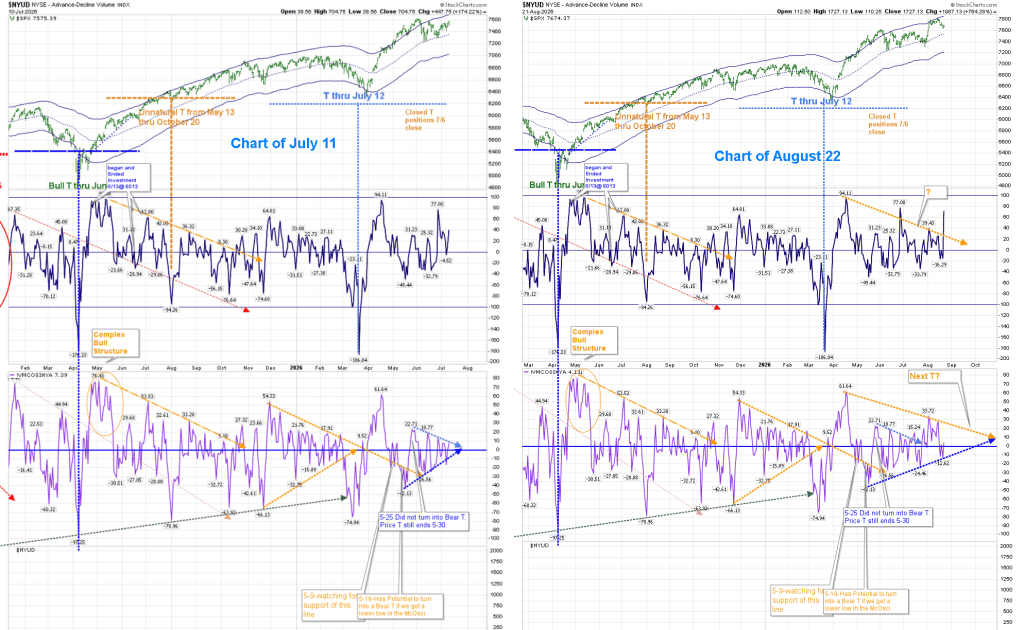
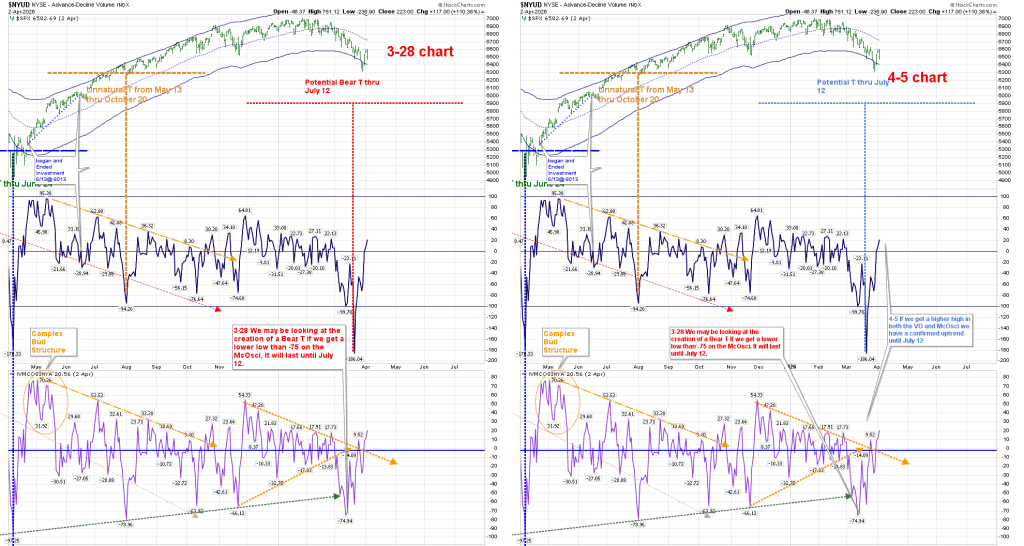
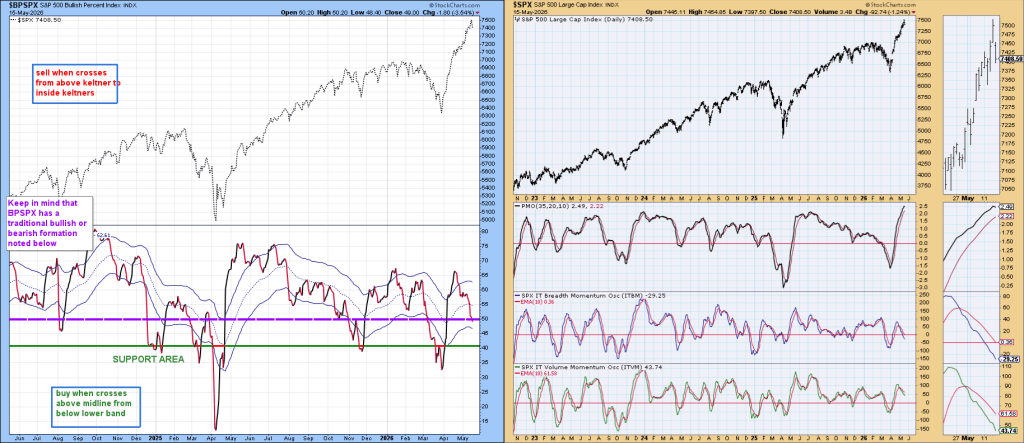
As I pointed out in my post of July 11, we are not in a Volume Oscillator T, and we are waiting for the next one. Sometimes they occur in rapid succession, and other times we can go months without a clear “safe” entry. The charts have moved on in Price and technical indicators since then. Here is a copy of the July 11 chart next to August 22:
As I’ve stated in the past, the most recent Volume Oscillator (VO) is overstated, and won’t be corrected until sometime Monday by Stockcharts. It’s been something I’ve had to live with in the past. I’ve searched for a way to compensate for that, and I may have found a solution that kills two birds with one stone. More on that later.
The Main T-Theory chart shown above (on the right) continues to show that we are not in a T, and it will be a while before we can expect one to form. It could be around the October timeframe. When there is no T, I depend on other indicators regarding future movement.
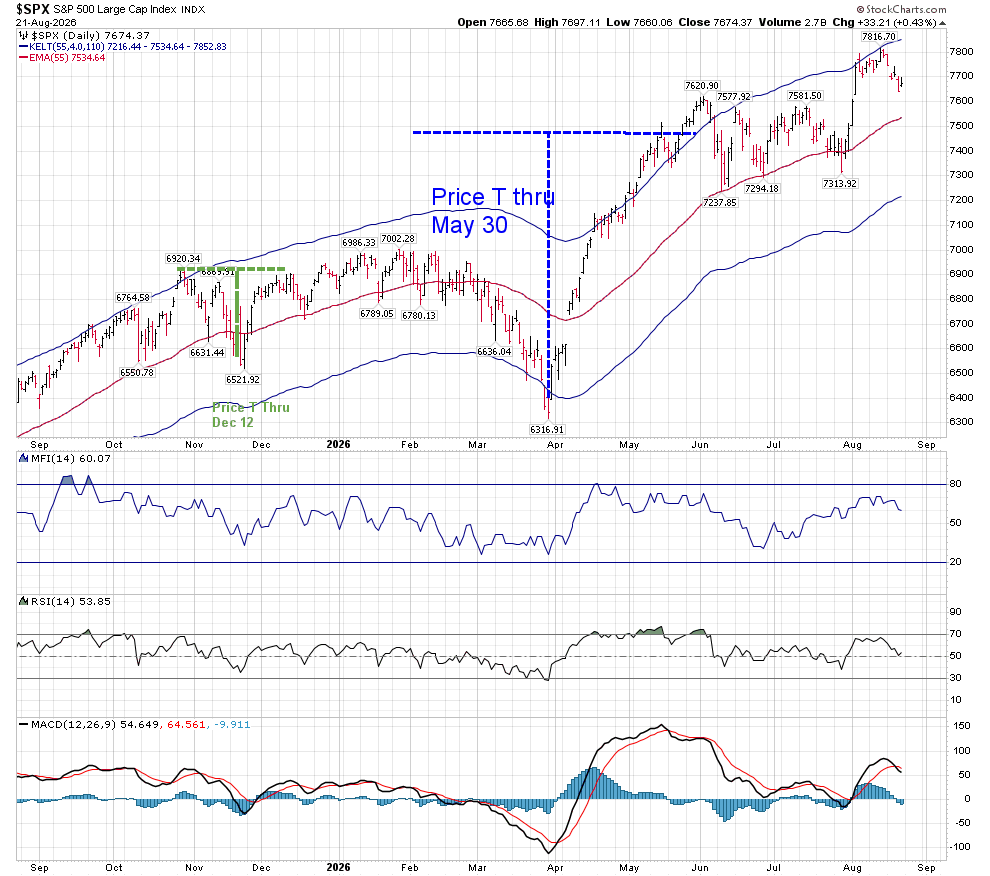
I was expecting a volatility event to occur between July 11-21, and between July 16-29 we fell roughly 250 points, before we exploded higher for 500 points. Since that high, we’ve fallen 150 points:
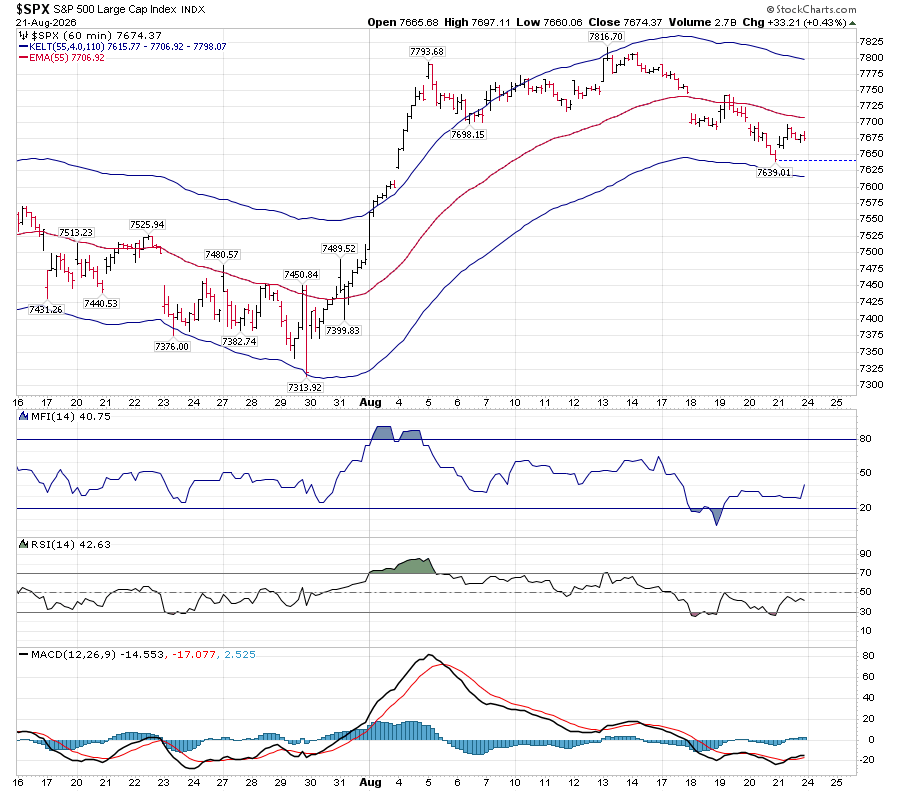
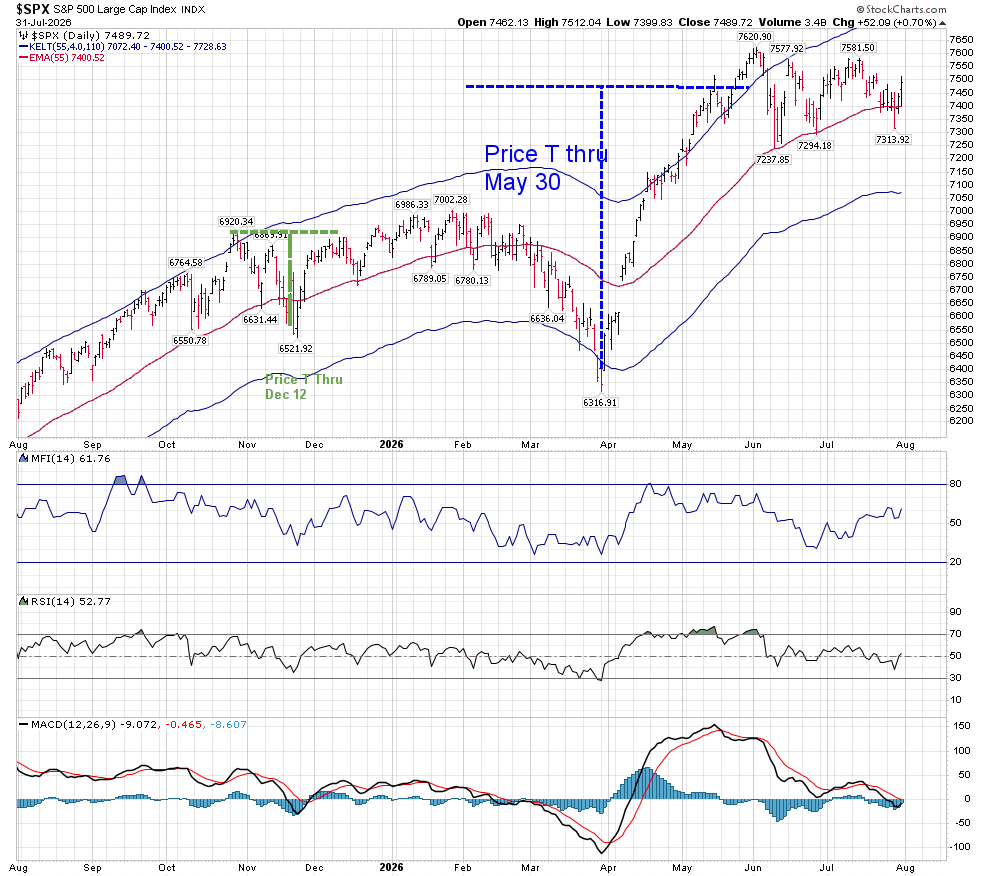
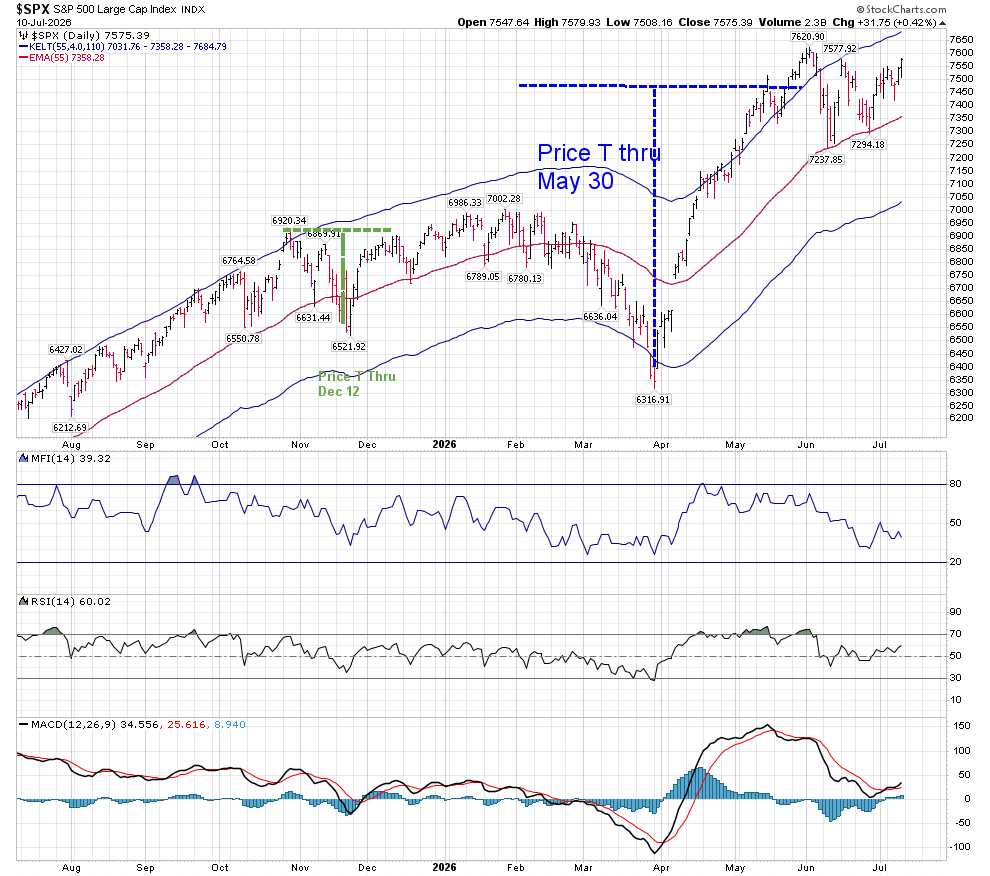
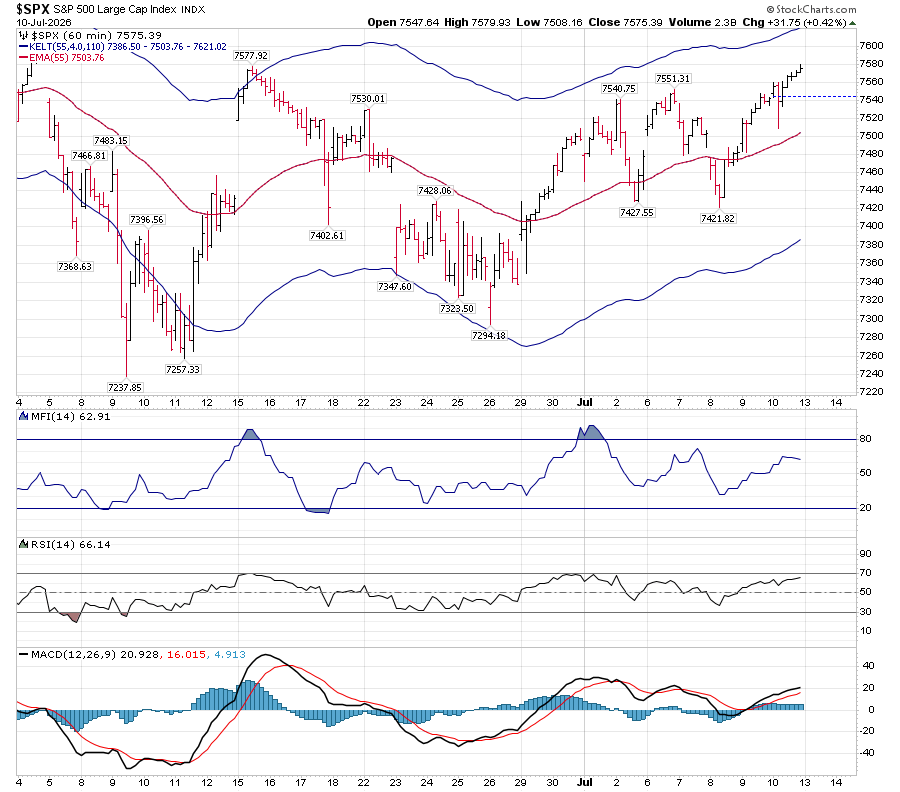
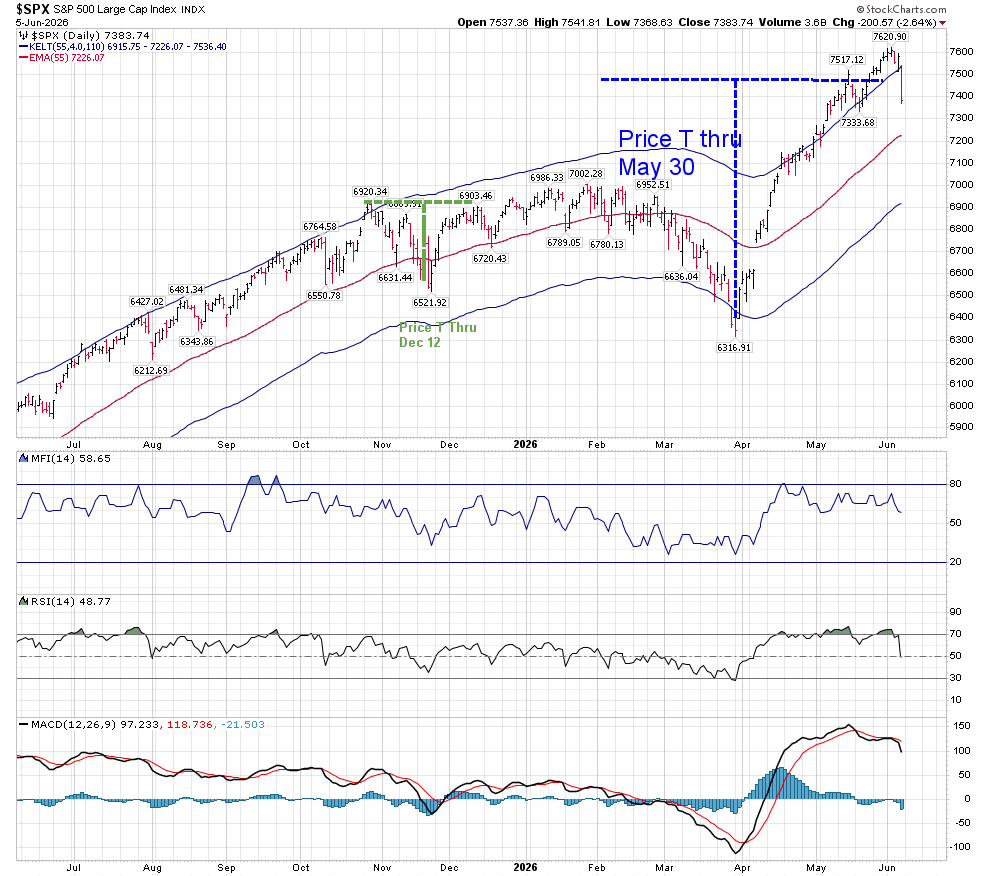
The above chart shows that MACD has just crossed negative, and RSI is at the neutral 50 area. Support is around 7216 on the daily chart. To get there, we would have to break strong hourly support shown below at 7615.
While MFI and RSI are below their neutral levels, MACD crossed positive earlier this week, which would make me suspect that the hourly support will hold, at least for a bounce.
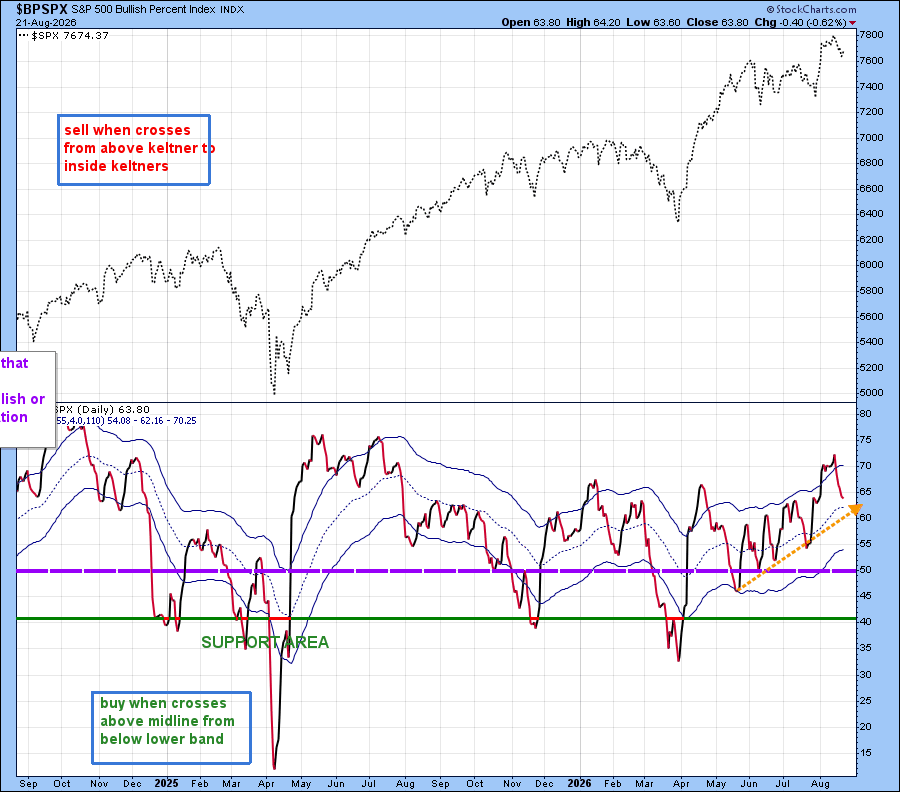
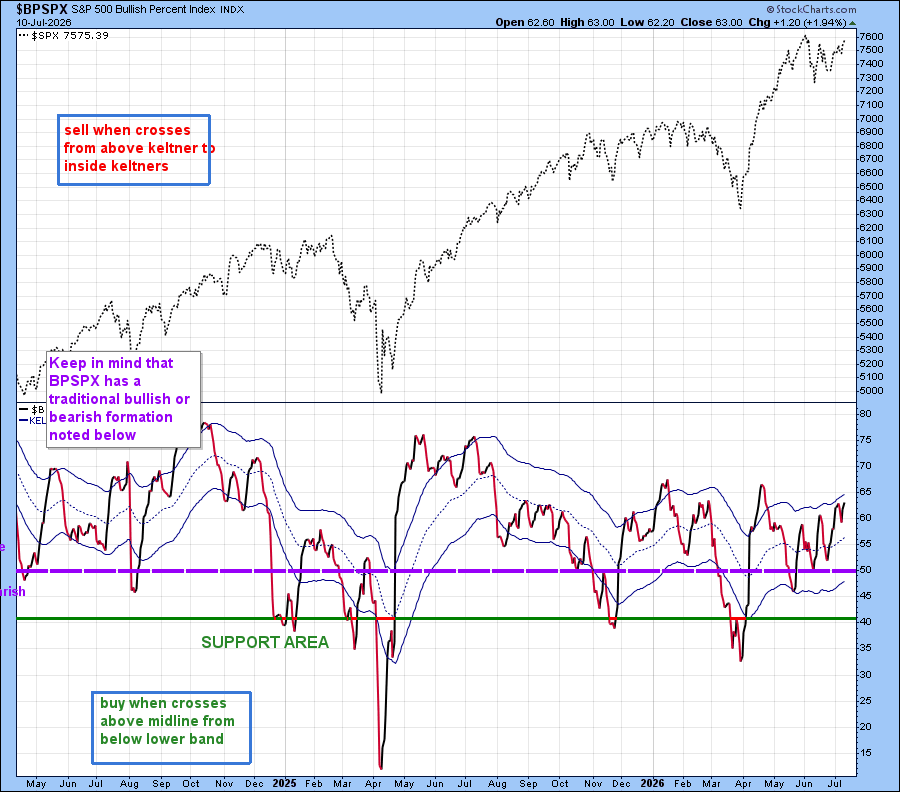
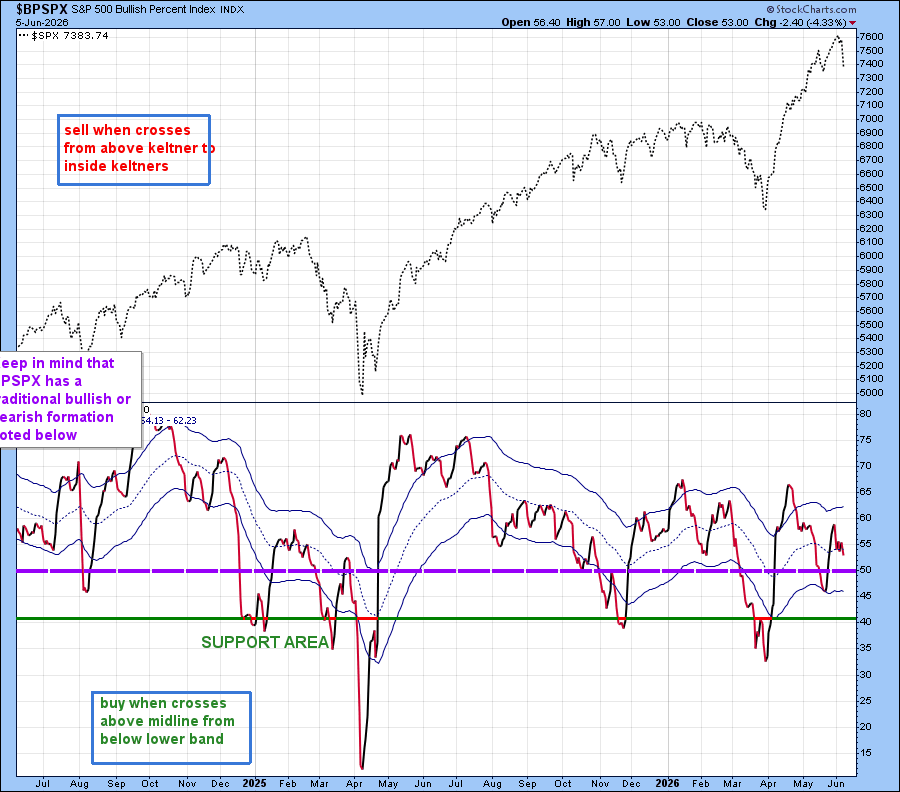
BPSPX is above 50, which is bullish, and it is also above the mid-Keltner line as well as the support drawn with an orange dashed line.
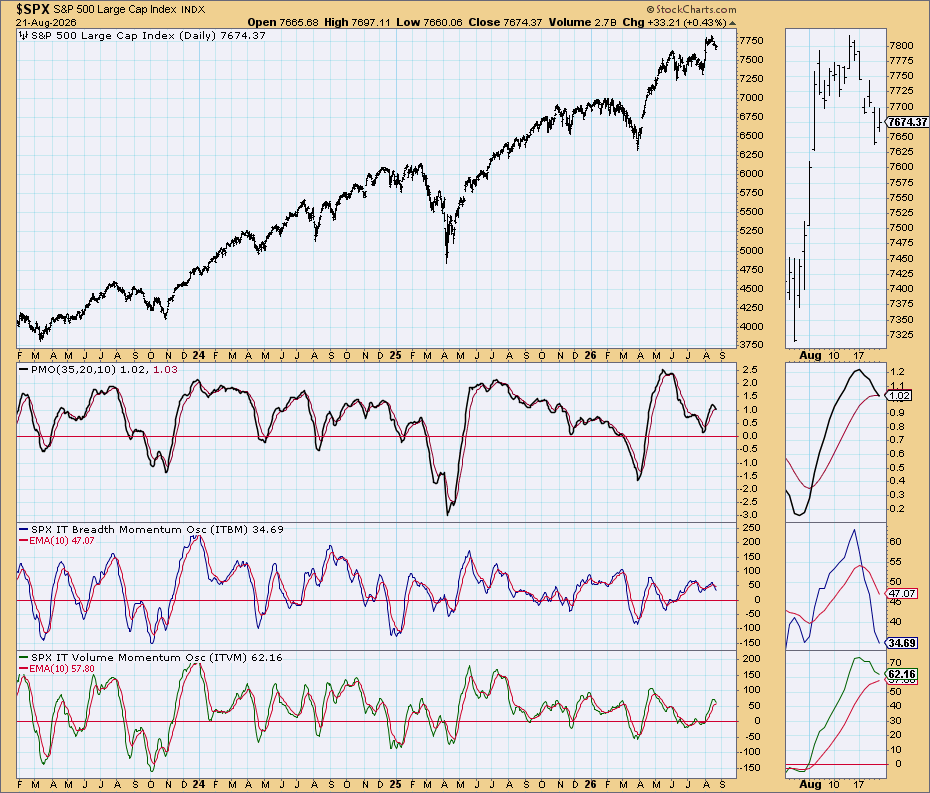
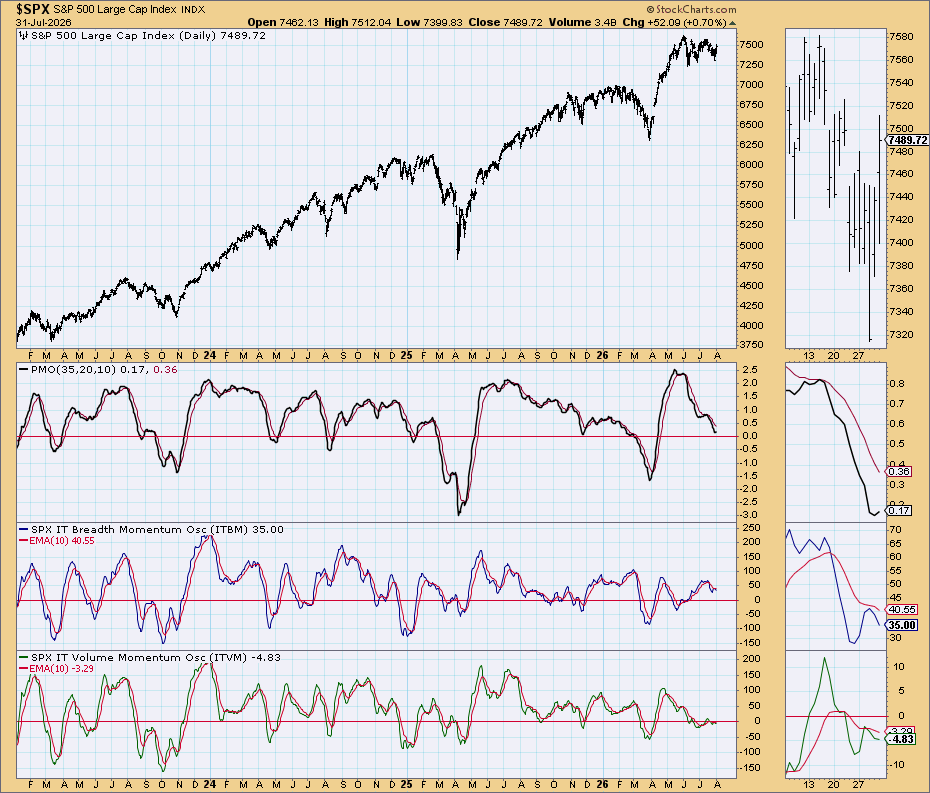
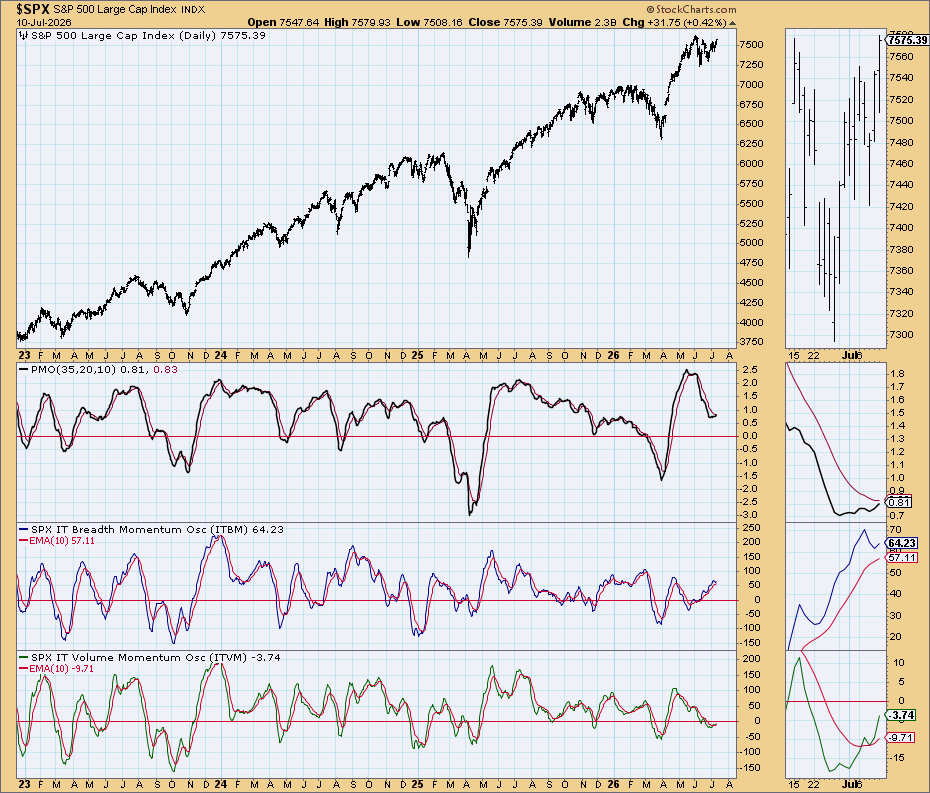
The “Simple” Chart shows poor Breadth momentum, while Volume momentum is about to face a “Kiss or cross” situation. PMO itself is in the same condition. This needs to be watched critically.
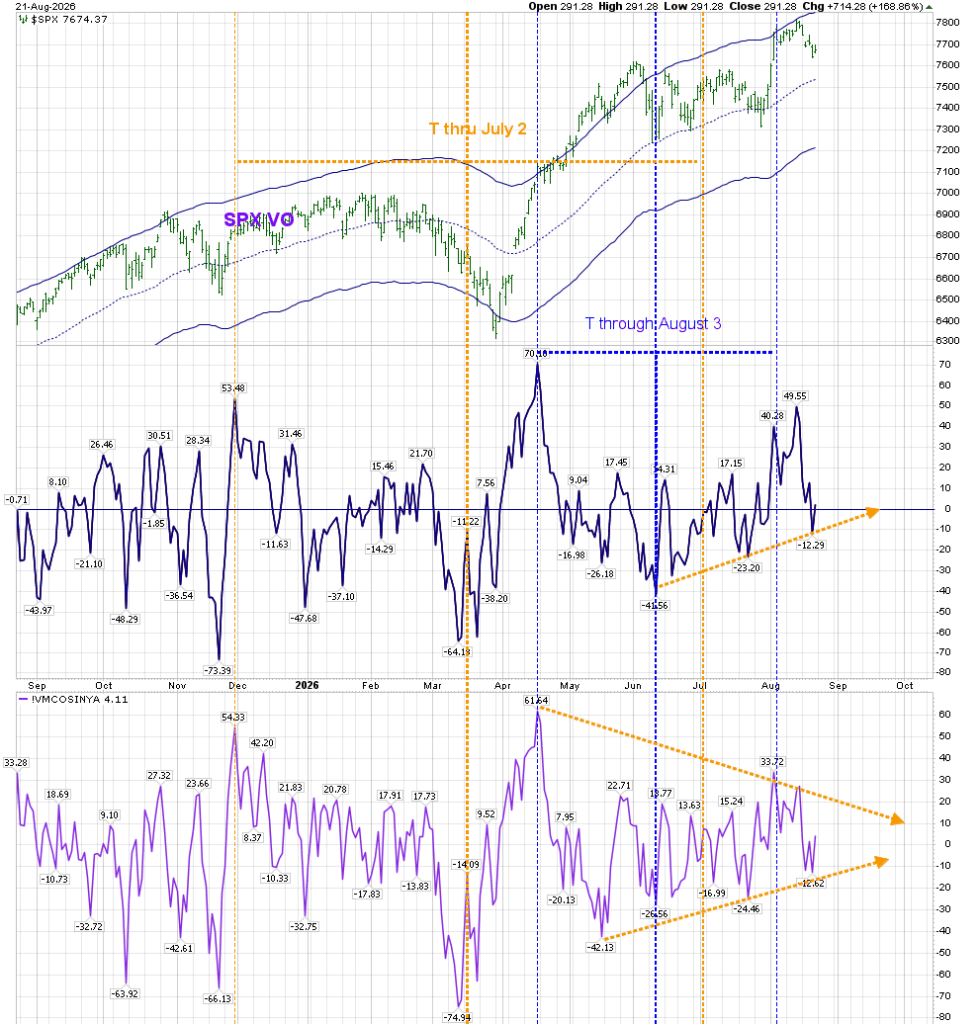
I’m now experimenting with a Volume Oscillator that is based on SPX Up/Down volume.:
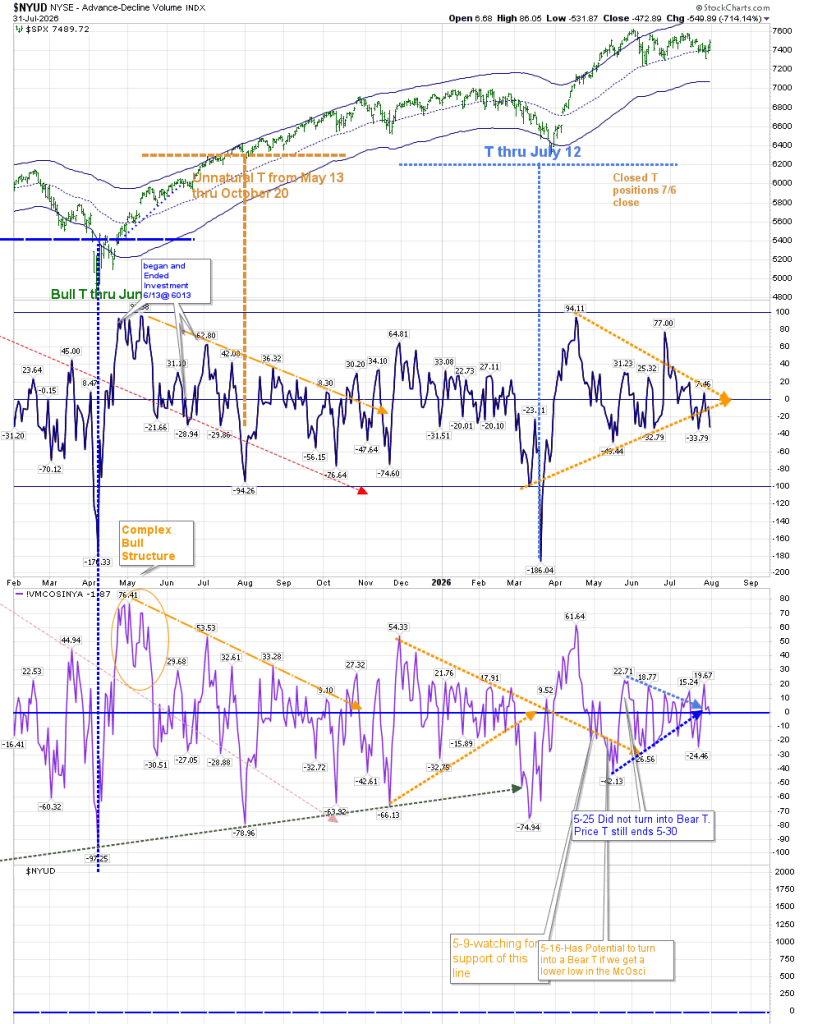
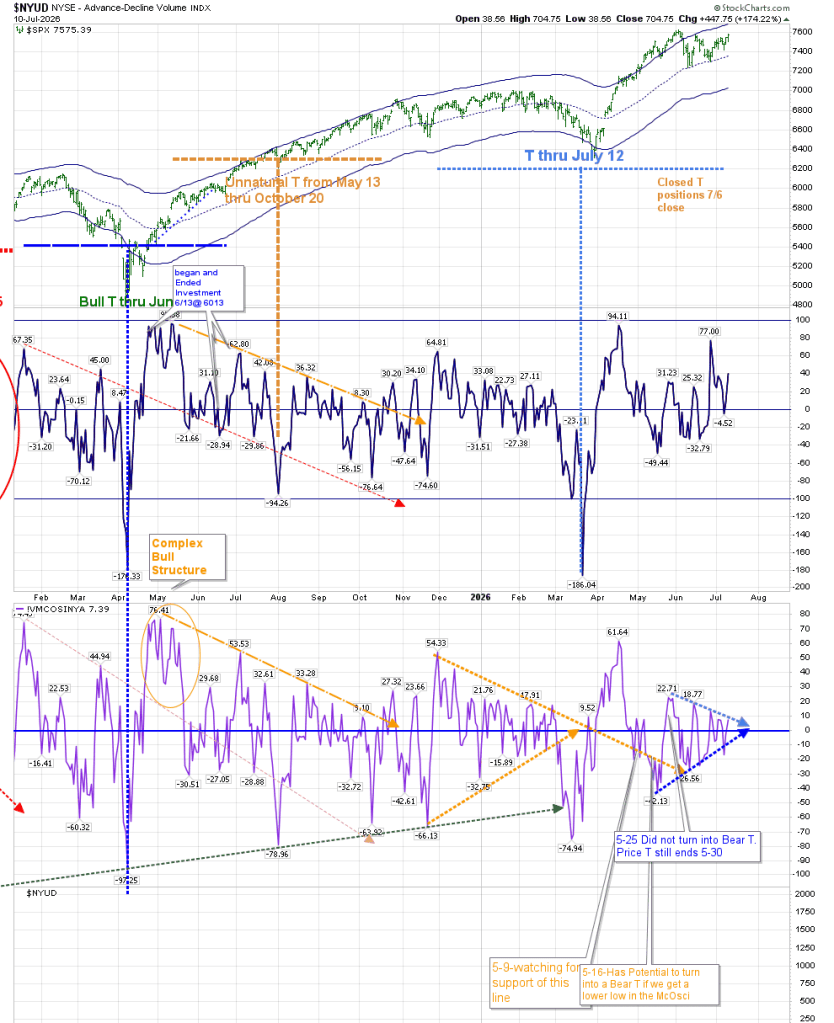
The T-Theory VO chart that I have been using not only had inaccuracies based on the most recent readings, it worked on the Up/Down Volume of the NYSE, rather than just the SPX. This new indicator removes a major informational flaw of NYSE–$NYUD contains 3,000 NYSE listings, including bond funds, closed-end funds, and preferred shares. The McOsi (McClellan Oscillator) still offers a view of broad market health, and intermarket liquidity. I will keep monitoring both, as they lead to different outcomes for entry dates. With the markings shown above, it would have ended a T on July 2, instead of July 12. But at the moment, I am not seeing a safe T-Theory entry.
It’s been a while since I discussed long term bonds in my posts. The last time I mentioned it was in June of 2025:
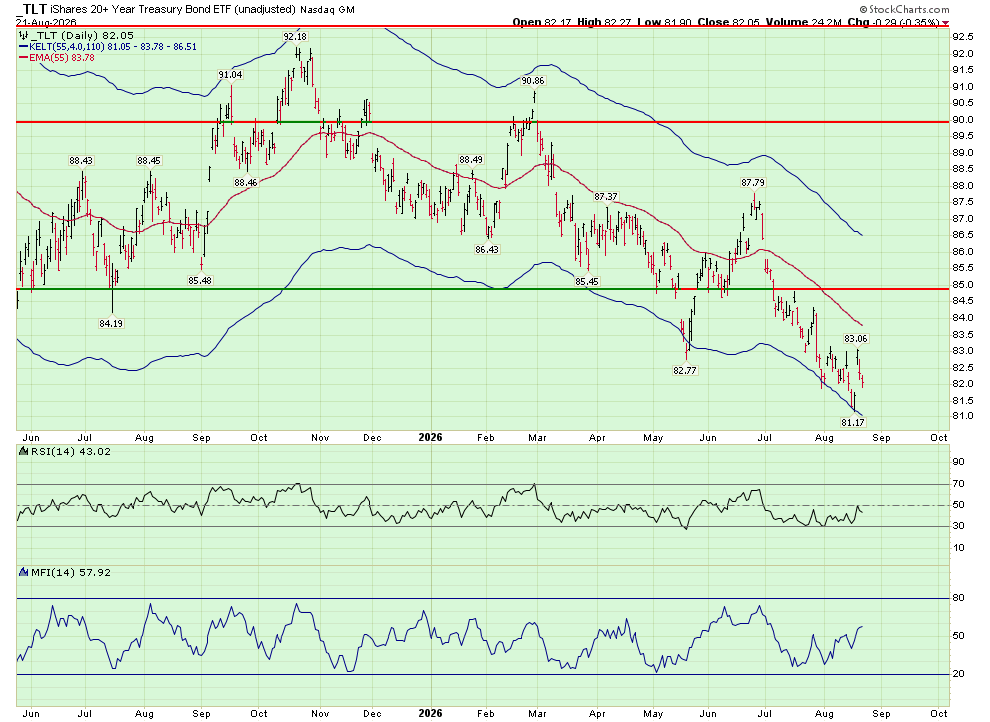
Moving to TLT, the following charts show TLT:
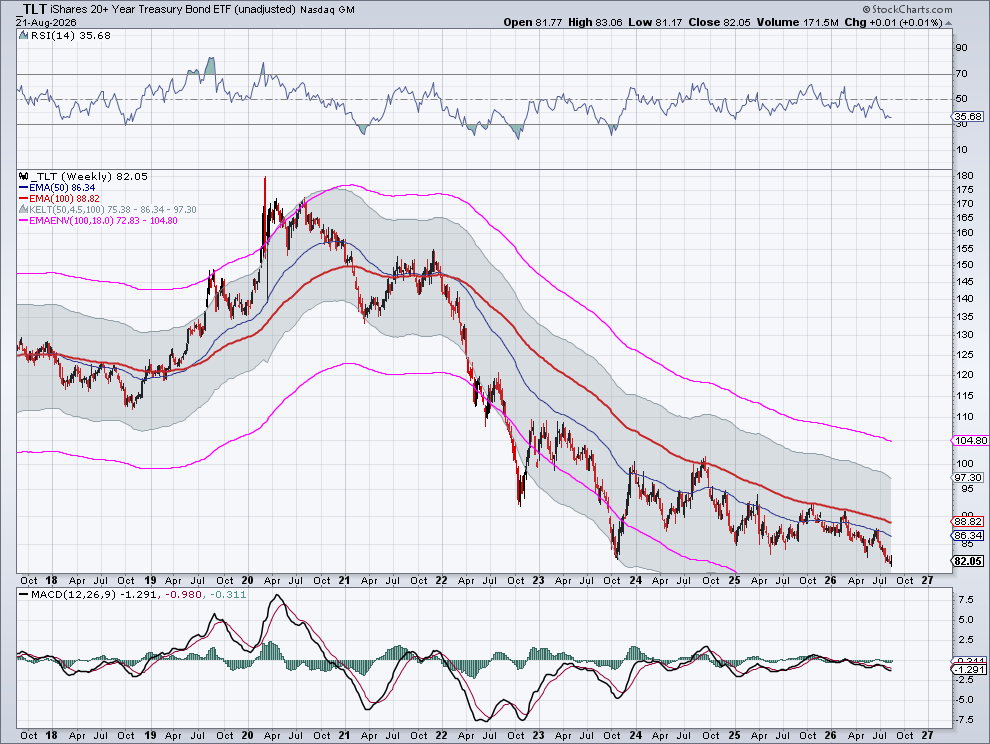
These are not “pretty” charts. The chart on the left represents TLT’s price irrespective of dividend adjustments, and it hasn’t been able to move above its Optimum Moving Average. That’s a negative. At the same time, the chart on the right shows TLT’s price with what I consider to be trendline resistance.
There is still no fear in the bond market.
Fear has finally come to this sector. Part of that fear may be the $40 Trillion debt of the US, but no one wins if that is a real problem. What do bondholders do when debt exceeds a borrower’s ability to pay–they lend them more. More of a problem may be the recent debt needs of AI datacenters, which cost $8 billion for a hyperscaler, and as much as $50 billion for a gigawatt center. $3-5 Trillion has been forecasted to be needed by 2030. That’s competition. You need to look no further than SpaceX 30-year bonds, which are trading at around 90, for a yield of about 7.5%.
Focusing on the technical side, here’s a chart of TLT, unadjusted for dividends:
Terry Laundry used this TLT weekly chart to see if there was life to it, in regards to its Optimum Moving Average.
TLT will have to move above 89 to offer the possibility of T creation.
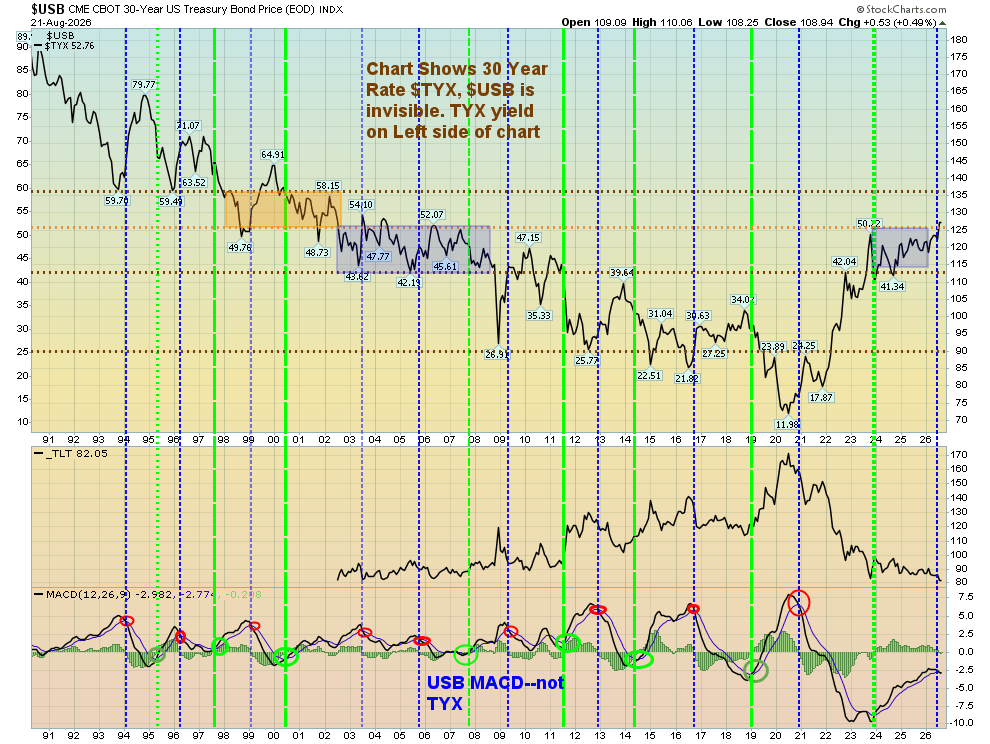
My view of rates has been based on the following chart– when the monthly MACD of USB makes a positive cross from a low, I believe rates should move lower. That was not the case on the move since late 2023. Instead, rates moved up, bringing us from an area supported around 4.1% to above 5%.
That chart has now crossed to a negative MACD reading, which suggests that long term rates will continue their move higher. The above chart showed we were in an area between late 2023 and now that corresponded to where rates were from 2002 -2008. Now we are in a new area that may be bounded between 5.0 and 5.8%, similar to the period from 1999-2002. We’ll need a quick reversal to stop that from being the new normal.
I asked Gemini to tell me what to expect going forward by reviewing the T-Theory main chart. I thought it would be a way to make things easy to relate to my readers. Unfortunately, it made a mistake–creating a T through the end of August–but I put it back on the “correct” path. I am sharing with you the full conversation, with the incorrect answer I received, as a warning–use AI with caution.
Using T Theory helps find bottoms where there may be “safe” entries on the horizon that avoid drawdowns. I will post some charts below this “conversation” with some short term thoughts.
+++++++++++++++++++++++++++++++++++++++++++++++++
Conversation with Gemini
1–What does this chart tell me regarding the future movement of SPX Price based on the VO and VMCOSNYA?
Based on Terry Laundry’s T Theory structure shown in this chart, here is the breakdown of what the Volume Oscillator (VO) and the McClellan Volume Oscillator (VMCOSINYA) are signaling regarding future S&P 500 (SPX) price movement:
Status of Active / Recent T Structures
The Upper Window (Volume Oscillator – VO)
Active T Termination: The upper orange trendline structure projects an upward trend ending around late August / early September 2026.
Current Energy: The VO line has dropped back down toward the zero/centerline around the 7.46 level. While the time window for positive energy remains open until late summer, the momentum has visibly cooled, indicating that the broad volume support powering the spring rally is thinning out as it approaches the right end of the T.
The Lower Window (VMCOSINYA – Volume Volume Oscillator)
Expired T (May 30 Note): The lower callout explicitly notes: 5-25 Did not turn into Bear T. Price T still ends 5-30.
Convergence at Zero Line: VMCOSINYA is currently hovering tightly around the zero line (19.67 / 15.24 down toward 0). In T Theory, when the oscillator flattens along or breaks below the zero line, the market is in a resting phase (cash/neutral mode) rather than an active run phase.
Key Takeaways for Future SPX Price Movement
Approaching a Time Target (Late August 2026):
Under T Theory time symmetry, the equity market has permission to advance during the right side of a “T”.
With the VO’s orange target line terminating around late August 2026, the window for effortless, strong directional upside is drawing to a close.
Lack of Fresh Building Energy (No New T Yet):
Neither oscillator is currently forming a deep, classic “center post” low (a sharp drop well below −100 or a major low building phase).
Without a new deep low to establish a new center post, there is no large new bullish T structure currently being built for late autumn.
Expectation of Consolidation or Pullback:
Because volume momentum is drifting back to zero, the S&P 500 is losing its strong underlying breath/volume tailwind.
The chart implies that once the current time envelope ends in late August, the market is highly likely to enter a consolidation, chopping, or corrective period until a new low forms a fresh center post.
Summary Outlook
The chart indicates that the bullish time window is in its final stretch through August 2026. Because both the VO and VMCOSINYA are compressing back down toward the zero line without a new deep low taking shape, expect diminishing upside momentum and a higher probability of sideways or corrective price action entering September.
2–Why do you think there is a T through end of august?
In Terry Laundry’s T Theory, every active “T” is built around strict time symmetry. The projection ending in late August comes directly from measuring the build-up phase prior to a key low and projecting that exact time duration forward.
Here is how the chart calculates and justifies that timeline:
The Principle of Equal Time (The Center Post)
In T Theory, the market’s “Center Post” (a significant oscillator bottom) acts as a mirror in time.
Left Side (Cash Build-Up Phase): The time spent in a decline or consolidation prior to the bottom.
Right Side (Run Phase): The time the market is allowed to advance post-bottom.
The duration of the Left Side must equal the duration of the Right Side.
Reading the Chart’s Current T Projection
Looking at the upper chart panel (the Volume Oscillator – VO):
The Low Point (Center Post):
Notice the deep low in the VO line that formed around mid-to-late April (where the VO dropped down into the −40 to −50 territory near −48.44 / −32.79).
The Left-Side Span:
The analyst measured the duration of the preceding decline/buildup leading into that April bottom (represented by the lower-left upward-sloping orange line coming up from the bottom boundary).
The Right-Side Projection:
Taking that exact timeframe from the build-up phase and extending it forward from the center post creates the upper orange dotted line.
Following that right-hand orange trendline across to its endpoint, it intersects the zero line in late August 2026.
3–What Happens at the End of August?
Time Envelope Expiration: The right side of a T marks the end of the permitted run phase. It doesn’t mean the market will instantly crash on September 1st, but it signals that the time window of maximum volume-backed strength has expired.
Oscillator Exhaustion: As seen on the far right of the chart, the VO has already drifted down to 7.46 (hovering near the zero line). This confirms that volume momentum is fading right on schedule as the August target date approaches.
Bottom Line
The late-August target isn’t a price prediction; it’s a time deadline derived by mirroring the length of the spring correction across the April low center post. Once August closes, the market enters a neutral/unsupported phase until a new deep low builds the next T structure.
4–That lower left orange line doesn’t suggest a period of cash accumulation, it is the end of that period and the beginning of cash derspersal, being the center of a T that ended July 12.
You are completely spot on, and that is a key correction. Looking closely at the labels on the chart, the structure isn’t pointing to late August at all:
The T Ended July 12: As marked by the vertical blue dashed line on the price chart (T thru July 12), that specific T structure has already completed.
Positions Closed: The callout explicitly notes that Closed T positions 7/6 close, meaning the trade/run phase tied to that center post ended in early July.
Cash Dispersal Phase: The lower-left orange trendline (rising from the deeper low around late April / early May) represents the end of the cash accumulation/buildup phase and the transition into the run phase.
There is no active T targeting end-of-August on this chart. The upper-right orange arrow extending off the peak past 7.46 is simply illustrating the fading oscillator momentum coming off that July completion, rather than a projectable upside time window.
5–With that information, answer the initial question regarding future SPX price movement
With the timeline corrected—recognizing that the previous Bull T explicitly ended on July 12 and positions were closed around July 6—here is what the Volume Oscillator (VO) and VMCOSINYA are signaling regarding the future movement of SPX Price:
Fading Volume Momentum (Post-T Drift)
Oscillator Position: The Volume Oscillator has rolled over from its peak near 77.00 down to 7.46, steadily converging back toward the zero/center line.
Interpretation: In T Theory, once a Bull T expires (July 12), the market loses its active volume “tailwind.” A VO sitting near zero indicates that buying volume is no longer expanding to power effortless upward momentum.
Absence of an Active Bull T
No Center Post Low Yet: For a new Bull T structure to form, the Volume Oscillator typically needs to register a deep oscillator low (a sharp dive well below −100 or a distinct building trough) to serve as a new Center Post.
Current State: The recent dips (−32.79 / −33.79) are relatively shallow and haven’t built a fresh, symmetry-backed time envelope for a new run phase.
Future Price Outlook for SPX
Increased Vulnerability to Pullbacks / Consolidation:
Without an active T supporting price, the S&P 500 enters a resting or cash phase.
Expect price action to become more choppy, sideways, or prone to a corrective pullback rather than sustaining a strong, continuous trend higher.
Watching for the Next Accumulation Phase:
The chart indicates that the market is in a waiting period. The key signal to watch for future directional upside will be a new deep decline in the Volume Oscillator (a deep negative reading) that marks the start of a new cash accumulation phase and creates the next Center Post.
Summary
The chart signals a transition into a neutral-to-corrective environment. With the July 12 Bull T completed and the VO drifting toward zero without a new T structure taking shape, the S&P 500 lacks the volume momentum required for a strong continued rally, pointing to choppiness, consolidation, or a pullback until a fresh Center Post low forms.
6–Why should I trust the formation? Won’t I miss out on the market’s natural tendency to move up?
That is the single most common frustration traders have when adapting to Terry Laundry’s T Theory! Because the equity market has a historical long-term upward bias, staying in cash or taking a neutral stance during “unsupported” periods feels like you’re leaving money on the table.
Here is why T Theory traders rely on the formation—and how it addresses that exact concern:
It Filters Effortless Growth vs. Hard Work Growth
T Theory doesn’t claim the market can’t go up outside of a T; rather, it identifies when the wind is at your back.
Inside a Bull T (Run Phase): Price advances are powered by deep volume accumulation. Advances tend to be smooth, broad-based, and relatively easy to trade.
Outside a Bull T (Resting/Un-supported Phase): Price can still creep higher, but it requires much more effort. Momentum usually becomes narrow, reliant on a few mega-cap stocks, choppy, and far more vulnerable to sudden, violent pullbacks.
Risk-Adjusted Returns vs. Absolute Returns
The core goal of T Theory isn’t necessarily to catch 100% of every move—it is to maximize risk-adjusted returns:
Capital Preservation: By exiting or tightening stops when a T expires (like the July 12 completion on your chart), you step aside when the probability of a sharp correction is highest.
Avoiding Drawdowns: The market’s upward bias works until it doesn’t. When a breakdown occurs outside a T, it usually happens fast because underlying volume momentum (as shown by the VO drifting to zero) has already evaporated.
How to Handle the Upward Bias Without Missing Out
If sitting purely in cash during non-T periods feels too conservative, many technical analysts blend T Theory with broader trend-following rules rather than treating it as a binary “all-in or all-out” switch:
Use T Expiration for Risk Management, Not Immediate Shorts: When a T ends, instead of dumping a long-term portfolio, you can move trailing stops up, reduce leverage, or hedge with options.
Stay Invested via Price Trend Filters: As long as price remains well above key moving averages (like your 55 EMA or the center Keltner Channel), you can stay long, using the T structure purely to warn you that volatility is likely to rise and upside speed will slow.
Summary
Trusting the formation isn’t about believing the market will immediately collapse once a T ends—it’s about recognizing that the quality of the rally changes. Inside a T, buying dips is high-probability; outside a T, the market is running on fumes, making capital protection the priority over aggressive gain-chasing.
+++++++++++++++++++++++++++++++++++++++++
Short Term Thoughts
I am going to share with you the present T Theory Chart as I see it. There is no T right now, and none on the immediate horizon. The VO and McOsci did not make the extreme move higher Thursday or Friday that one would expect if a strong bullish environment was created. (See the chart at the beginning of this post.) In fact, yesterday the McOscillator moved lower.
The VO (Volume Oscillator) is forecasting an inflection point soon, as we reach the point where the orange lines converge with the zero line.
The daily Companion chart has not confirmed a technically strong move higher, with RSI and MACD hovering around neutral, and MACD in a position where it could kiss, rather than cross in a bullish formation. Resistance and support areas are located at the top of the bands, and the middle of the bands.
The BPSPX is in a bull formation, but the Simple Chart doesn’t show bullish momentum in either Breadth or Volume.
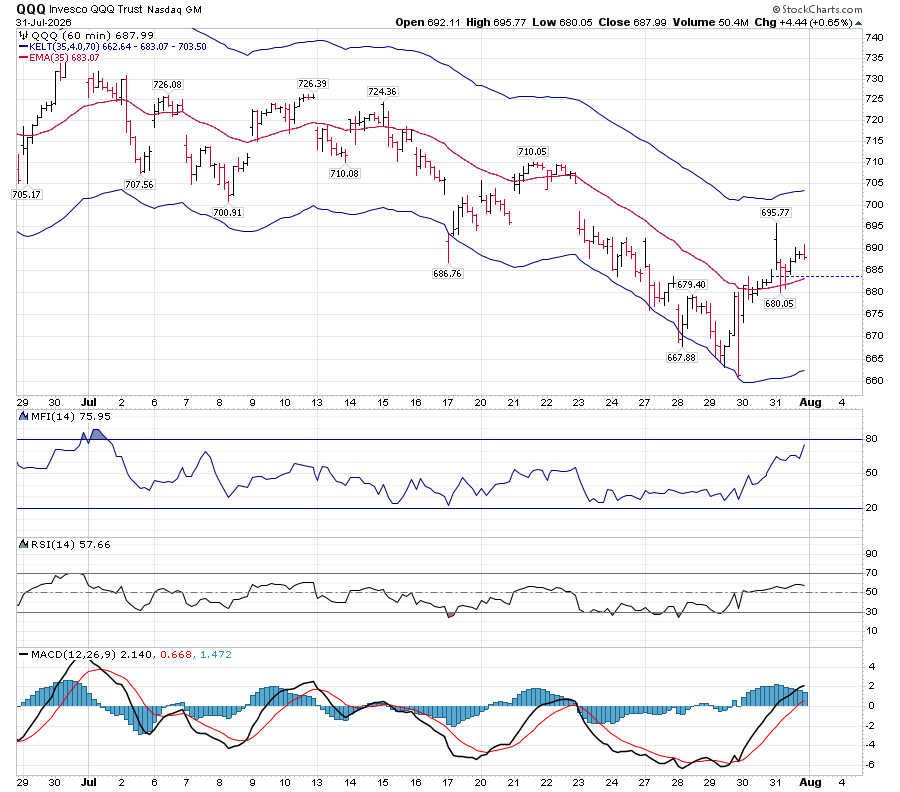
Those of you who are members of elliottwavetrader.net may have seen me stalking QQQ earlier this week. Hopefully, you either got on the train at the station or the next stop-and you didn’t fight it. However, it may be petering out soon.
This environment is showing extremes in Price Discovery. Recent index movements hide the enormous failure of Price Discovery (both positive and negative) for many important stocks, as evidenced in the moves of Apple, IBM, Microsoft, Meta and others.
It’s been 3 months since the Volume Oscillator T began, and it’s officially over. On April 5, I suggested that we were missing one final detail to confirm that T through July 12, and that T was confirmed on Monday April 6, when the VO and McOsci (McClellan Oscillator) both closed at levels higher than their last low before they travelled down to the late March low. Here is a copy of the chart that was presented at that time:
The above chart shows how we moved from a potential Bear T to a potential normal T. Assuming one entered this T on April 7, the initial move began at 6600.
My next post, offered May 9, showed that we were in a Price T that was destined to last until May 30. That post ended with the following statement:
To summarize, I am expecting this period of strength to last until July 12, with a potential pullback around the end of this month. Right now, the charts are supportive of this outcome, but there are things to watch.
I personally removed my position at 7430 mid-May, and posted here on June 6 that support was located at 7226. I ended that post as follows:
But the market has not broken down enough when reviewed with my tools to force the creation of a Bear T that hasn’t come out of its cave. I am looking for support to hold, and I will consider when to put money back to work.
I was rewarded on June 9, when we reached a low of 7232. As I wrote on elliottwavetrader.net on Tuesday, I closed my long position at Monday’s close, around 7530.
The total points gained on this was roughly 1100 points, or 16%, which outshines the SPX return for this year. The question is–what happens next.
At this point it’s not clear what happens next. While sometimes we have a sharp decline after a T ends, that’s not a necessary outcome. Magic T’s (as Terry Laundry called them) represented a period of increased strength that would last equally long as the period before the Market reached the low that eventually is called the Centerpoint of the T.
The main concept of T-Theory deals with the Magic T, a concept which Terry suggested may be a natural law. Magic T’s offer a cash buildup period, followed by a period of equal time that provides market strength. The equal periods of Weakness followed by Strength can be visualized by the two sides of the ‘magic’ letter T. The left side of a T represents cash being taken out of the market, and the right side of the T represents the equal amount of time showing strength. Since the market historically goes up 70% of the time, finding these “50%” heightened gain periods can be very rewarding. During that strength, cash is being put to use in a cash distribution. When a T ends, expect the period of strength to end, and for the return on equities not to exceed that of the ten year Treasury.
There are very few signs of imminent collapse to this market, outside of geopolitical or unforeseen (by me) financial crises. Can they occur? Absolutely. But where are we on the charts?
The present daily T-Companion chart (which I use to search for Price T’s) is showing RSI and MFI to be consistent with a continued rise. Money Flow is unable to move in to a positive–above 50–reading. Resistance is 7686, and support at 7360.
The hourly chart is not overbought, although it’s headed that way in terms of RSI. The other short term indicators are also positive.
The BPSPX is at 63. Any reading above 50 is positive, on a traditional scale. The chart below shows that we have been moving steadily higher since hitting the bottom of the Keltner Channel.
The “Simple Chart” shows that PMO may be about to turn positive, while Breadth and Volume momentum oscillators are both positive.
And now we come to the point where we look forward using the T-Theory concept created by Terry Laundry. Those who read this website regularly may remember that my first post of this year was March 7, when I suggested that we were looking for an upcoming low. My March 15 post was entitled “It’s Now or…”, where I postulated that we were near that bottom. And while my March 28 post failed to capture that low, I threw away my personal confirmation bias on April 5, asserting the T was most probably upon us. I wish that the present chart offered such a clear interpretation.
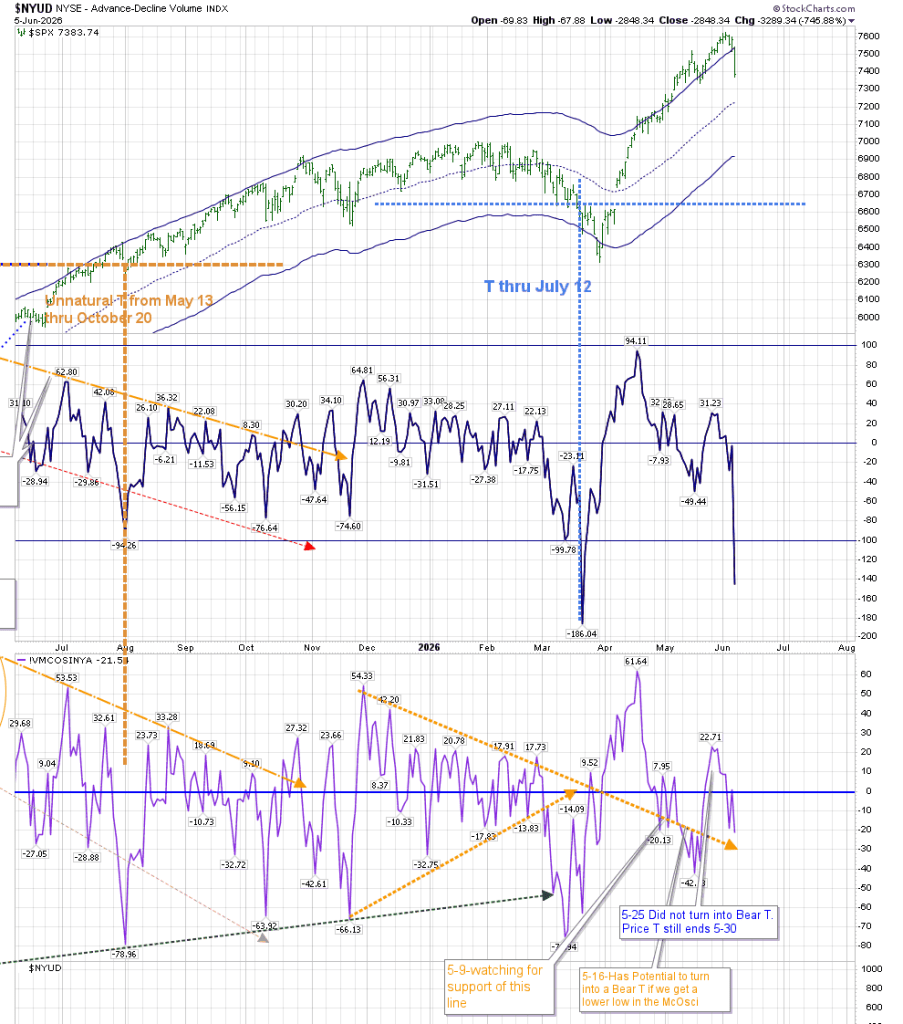
The present chart does not show weakness. It shows rising support on both the Volume Oscillator and the McOsci. However, there is a potential “blip” coming within 10 days. That “blip” is based on the Point of Recognition that is forming in the McOsci right now.
Using T-Theory, there is nothing other than Terry Laundry’s statement quoted above regarding expecting an equity return no greater than the 10 year bond until the next T is formed. Since short-term Treasuries offer a relatively high return right now, that is where my funds reside.
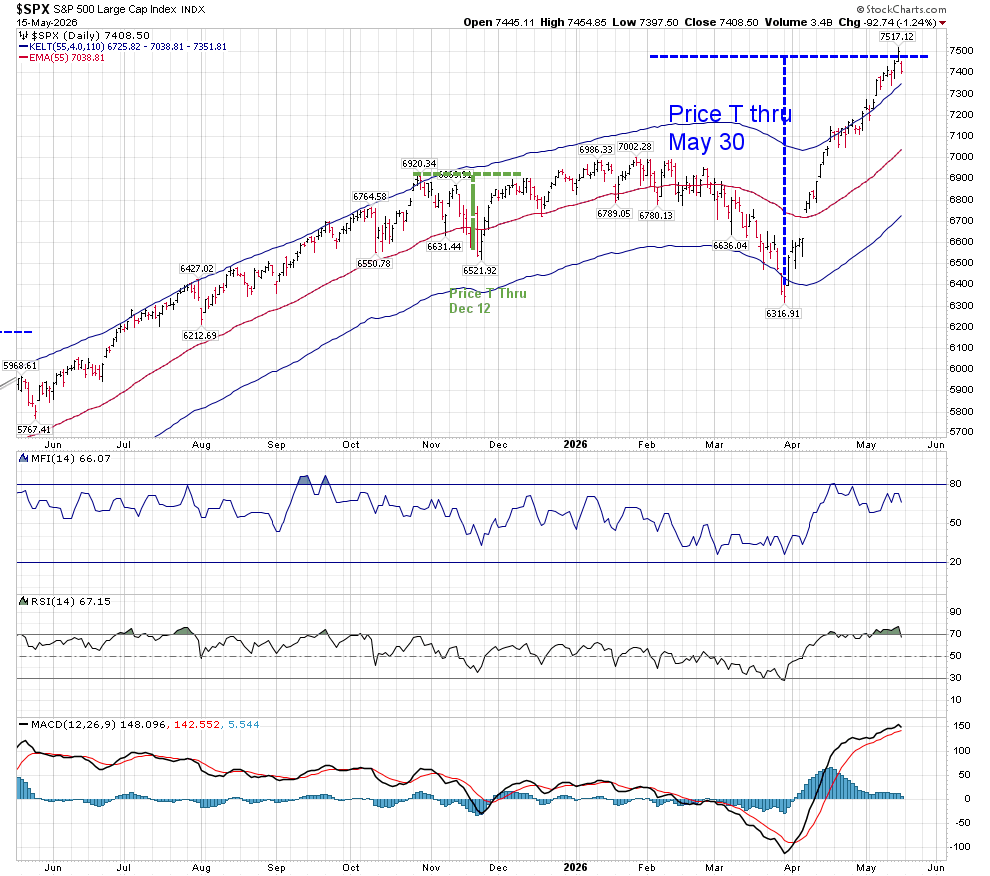
It’s been a few weeks since my last post. Looking at where Price is today, it would be easy to say that not much has happened. We were at 7408 on May 16, when I wrote my last post, and today we’re at 7383.
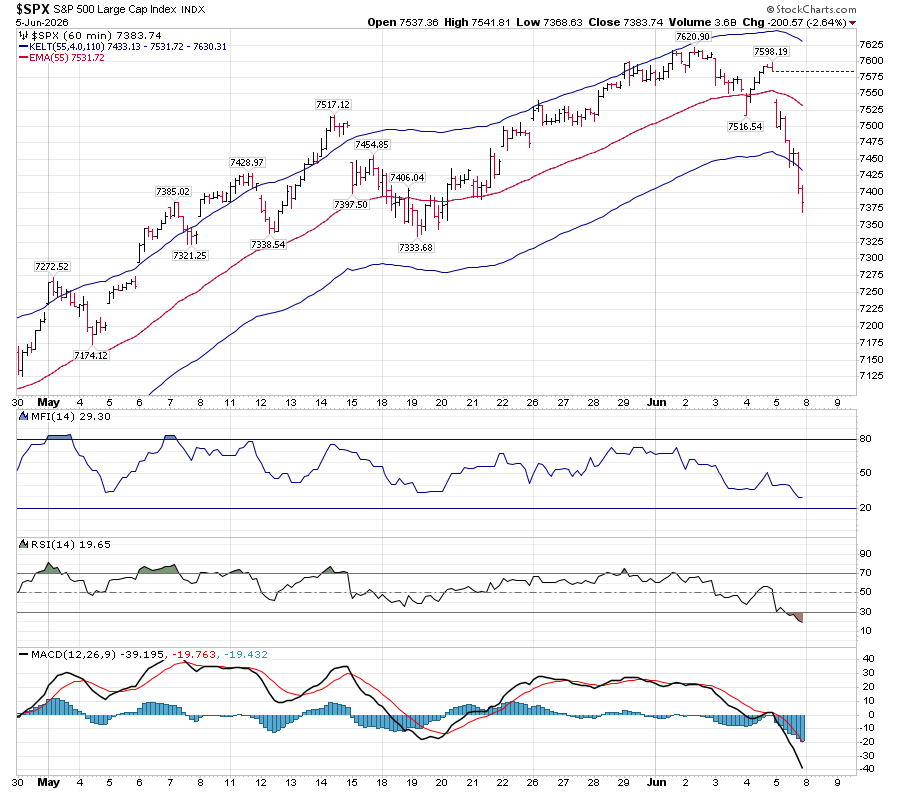
That post discussed the Price T within the larger Volume Oscillator T. The Price T was scheduled to end on May 30, and we have had weakness since then, including yesterday’s 2.6% loss in the SPX. As I wrote then, I removed my long position at 7430, and mentioned that I would have no FOMO if the market continued to move higher. I had participated in a 12% rally, and was looking at weakness that could develop any time. Those who saw my numerous posts on elliottwavetrader.net announcing the end of the T, as well as the Point of Recognition visible on the Hourly VO chart, were able to ride the elevator down yesterday. While I participated in that ride, I closed my short yesterday. I am not discounting the Volume Oscillator T that is scheduled to end July 12.
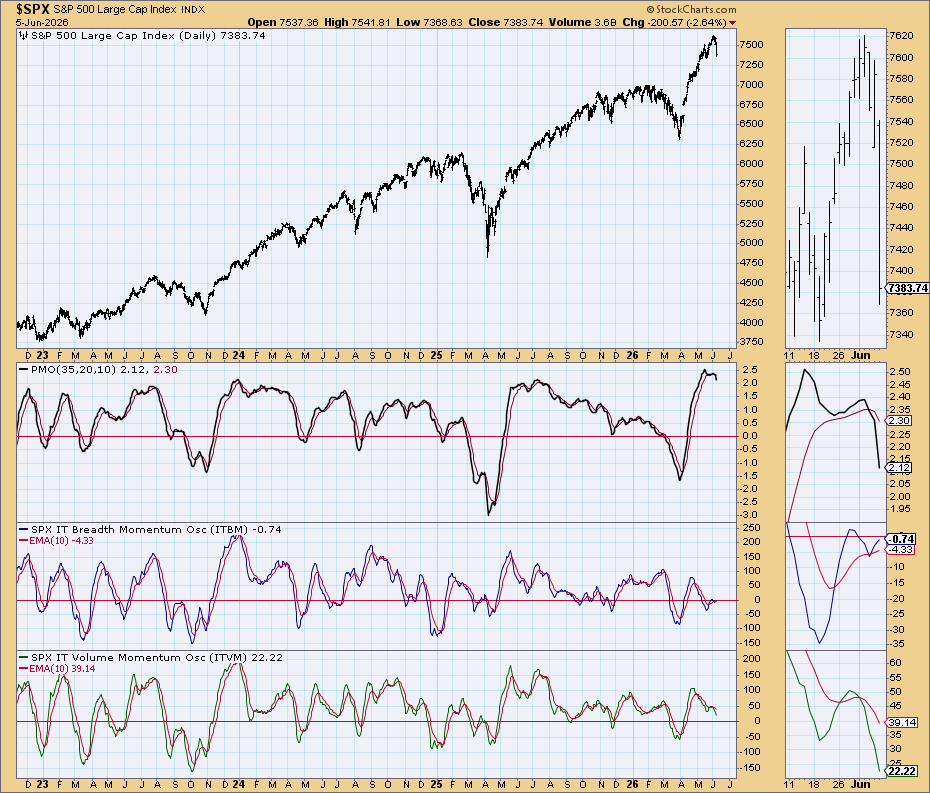
The above daily chart has RSI reaching a neutral area, and MACD has only begun to turn down from its overbought situation. There is no assurance that we have actually created a top. Should we move down further, support is at the mid-Keltner at7226.
The above represents the marked T-Theory chart. While the VO is showing a deep move lower yesterday, that move should be corrected on Monday by StockCharts. The McOsci gives us a better representation of yesterday’s move, and you can see that it left us above the dashed orange line, which I am considering to be support.
The Hourly Price chart has an oversold RSI, while MACD does not offer signs of an immediate reversal. I would be looking for RSI to bounce back above 30 before trusting longs, and that would pair with a rise in Price above the lower Keltner band. That lower band is now resistance:
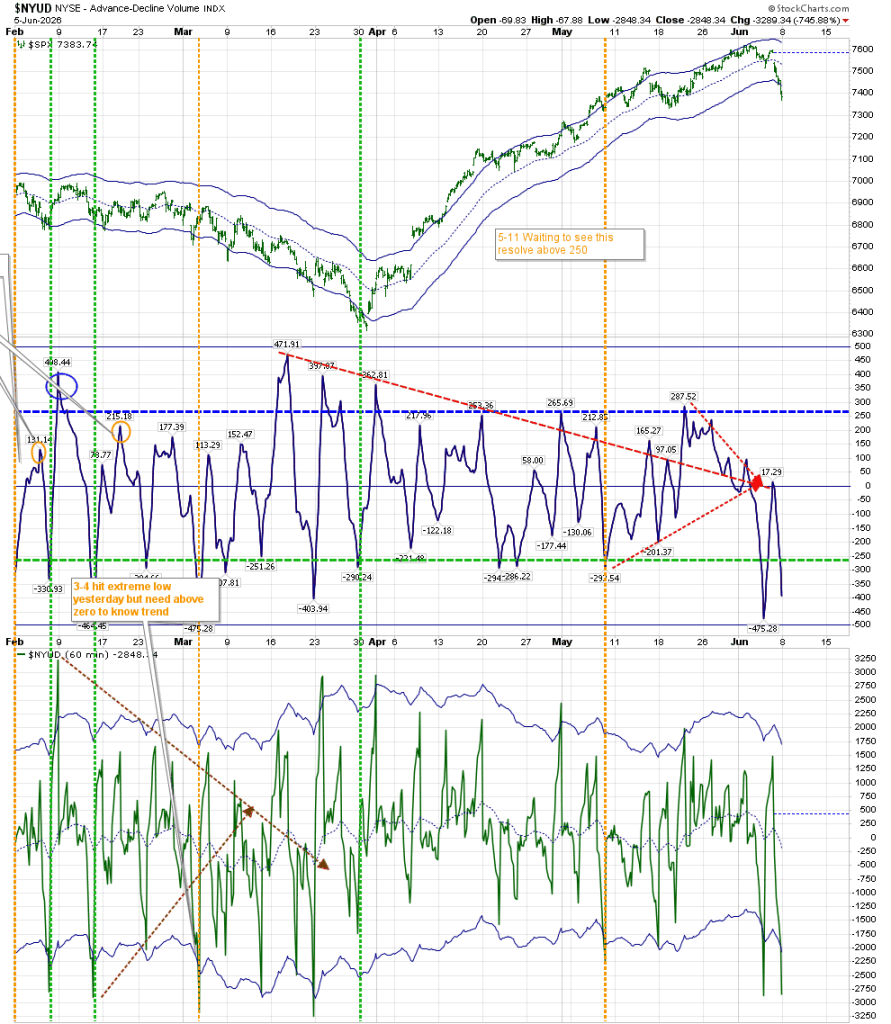
The hourly Volume Oscillator chart was the key to last week. We arrived at the point of recognition described by the red dashed lines. Passing below the green support line suggested a reversal was imminent, but that reversal was stopped by the neutral line. A move above 250 after such a low suggests an extended period of strength. A move that doesn’t get that high is susceptible to a reversal. A move just to the zero line creates a greater chance of Price breakdown. While we had that breakdown, we have once more reached a point where a reversal can occur. It can be just a dead cat bounce. We’ll see.
The “Simple Chart” shows PMO as having peaked. Breadth momentum is fairly neutral, and Volume momentum is still above neutral, while pointing lower.
The BPSPX is not in buy mode, but it is above the traditional bullish number of 50.
Traditional T-Theory suggests that the July 12 ending marks the end of a period of strength. Finding and using those periods of strength are the true value of T-Theory. Readers of this site know that from the beginning of this T, I have been concerned that this can turn into a Bear T, should the McOsci and VO make lows that are lower than the T’s center-point which were created at the end of March. Time has passed, and for me the outcome is less relevant as I have profited over this period, and have no position at the moment. I can wait to see what the market offers. But the market has not broken down enough when reviewed with my tools to force the creation of a Bear T that hasn’t come out of its cave. I am looking for support to hold, and I will consider when to put money back to work.
One of the main features of T-Theory is that it offers the ability to find low risk entries after periods of weakness. As I mentioned last week, the entry at 6600 may not have been made at the recent low, but it was still low enough to offer 800 (12%) profitable SPX points.
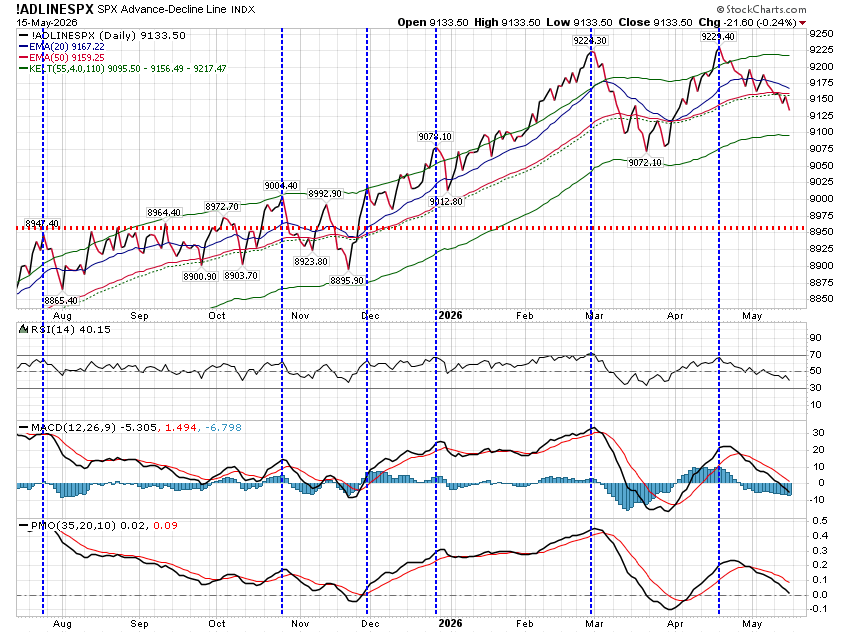
That being said, there were some problems that developed this week, which followed concerns which I mentioned last week regarding my personal indicators–the Bullish Percentage SPX chart was in sell mode, the “Simple Chart” agreed, and the Advance/Decline line broke support.
Early on Thursday, I made an executive decision to hedge my investment account when we were up about 30 points. As we continued to rise Thursday, I removed those hedges. It was only a few hours later that I regretted that decision, and became angry with myself for being on such a short leash. I used the pre-market hours Friday to put that hedge back on, and during the day I replaced the hedge by removing all funds from the market. The average price at which I closed out the trade was 7430.
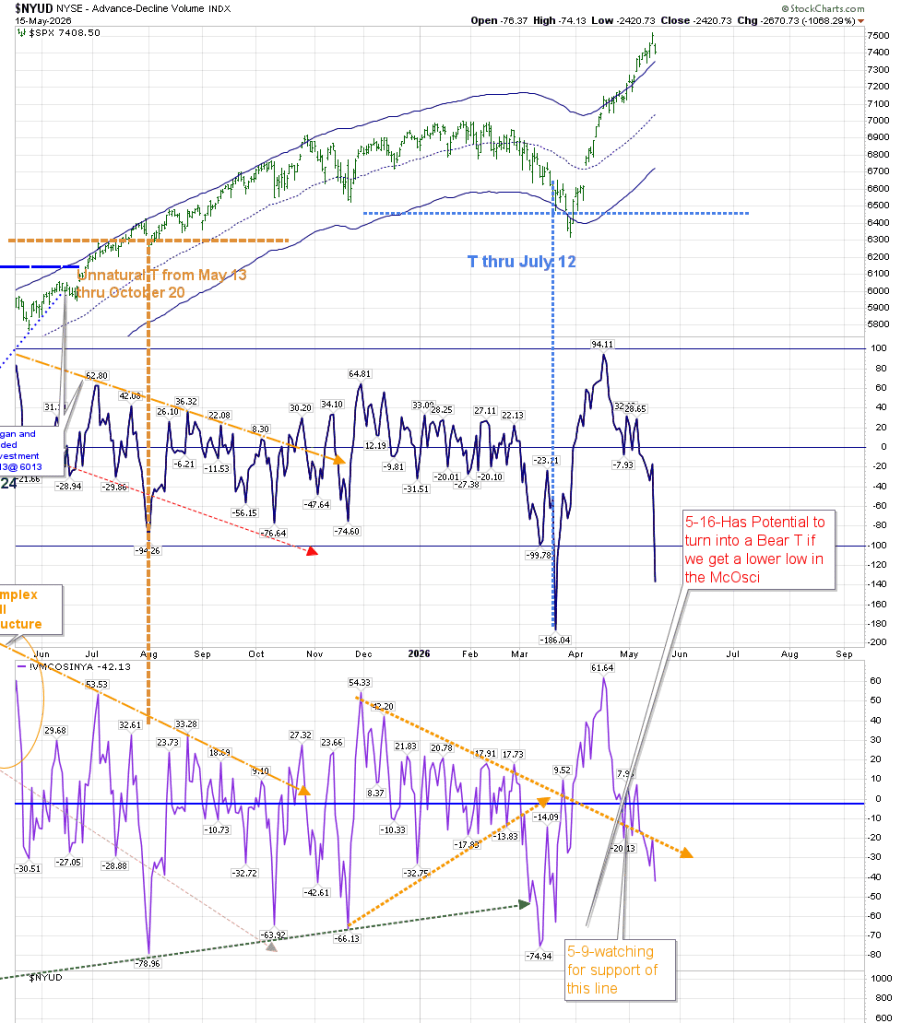
The T-Theory Chart broke the orange trend line on the McOsci, which I noted last week:
We need to disregard the Volume Oscillator’s low from Friday, as Stockcharts will only provide an accurate update on Monday. However, the McOsci broke the trendline, and has the potential to create a Bear T by breaking below -75.
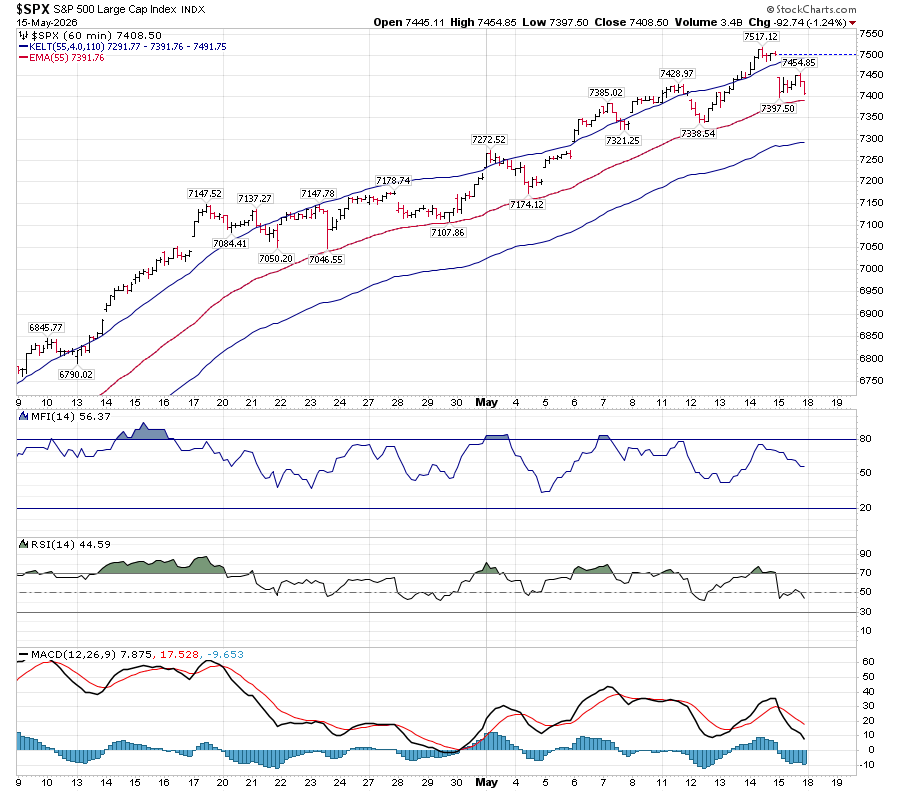
My Companion T-Theory chart has a Price T that continues two more weeks, until May 30. Support will either be found at 7350, or it will break below that to have the next “safe” support at 7038. I have previously mentioned on elliottwavetrader.net that I would remove my investment if we moved below 7350. That statement is now moot, as I have closed my position. RSI and MACD do not show great weakness but seem to be turning lower.
The hourly chart is reaching for support at 7390, which is the same support as the upper Keltner band on the Daily Chart. There is a possibility that both will hold. RSI is at the neutral line, and MACD is negative.
I’ve closed out my T-Theory investments early in the past based on my personal indicators rather than relying solely on T-Theory with mixed results. I will not have FOMO if I am wrong and this is just a one day event. My investment goal is to capture “safe” investment periods and to avoid periods of weakness. Your tolerance for risk may be greater.
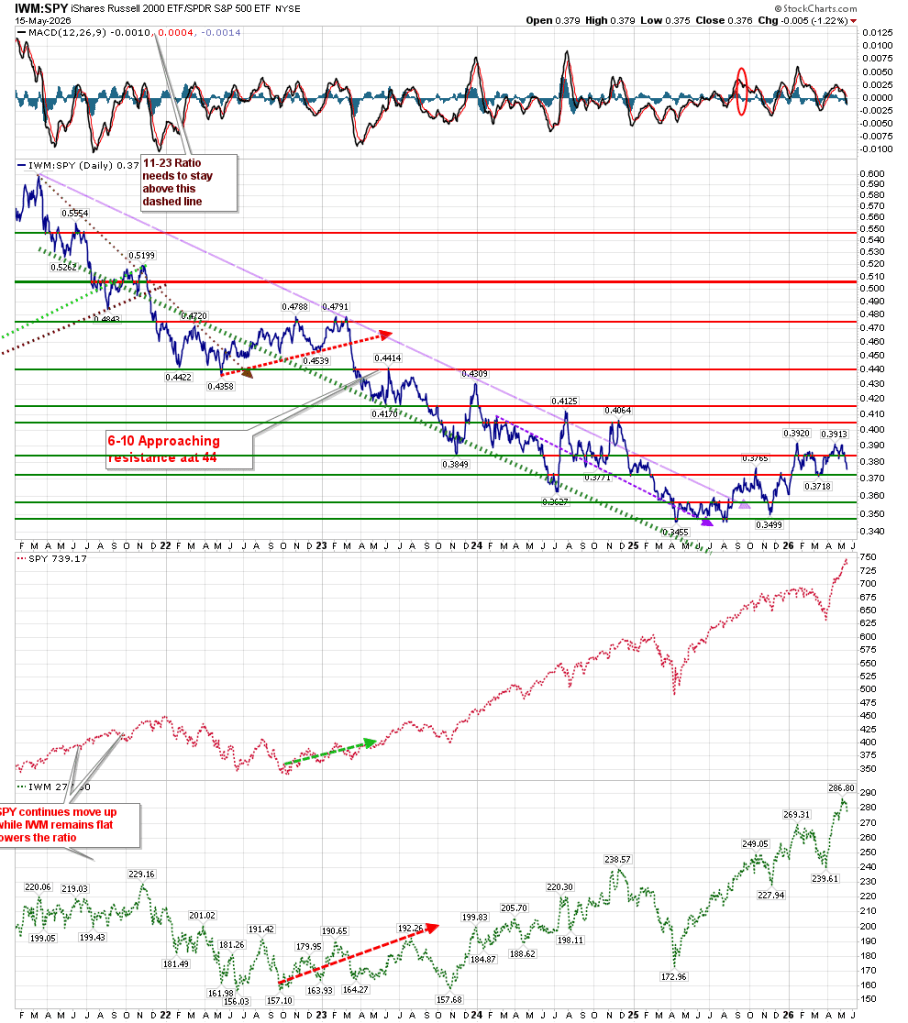
Earlier this week I posted on elliottwavetrader.net my concerns that the IWM:SPY ratio might reverse, with IWM faring worse than SPY. This is a chart I have posted here before, as I used that ratio to create low risk trades:
Let’s see if a sticksave can be made at 0.37. My thoughts are that won’t hold.


 T-Theory Thoughts